THE VEGAN TABLE — A World of Plant-Based Food.
ORIGINS 001
01 — A Small Fried Bean Fritter with a Surprisingly Delicious Secret
Break open a small, golden-brown fritter.
The outside is fragrant and crisp; inside are finely ground beans and herbs. The warm aroma of cumin mingles with coriander and garlic.
This is falafel.
Across the Middle East, it is a familiar everyday food, often tucked into flatbread with vegetables and sauce.
Better still, it can be made without meat, eggs or dairy products.
But which beans go into falafel?
Many people might answer: chickpeas.
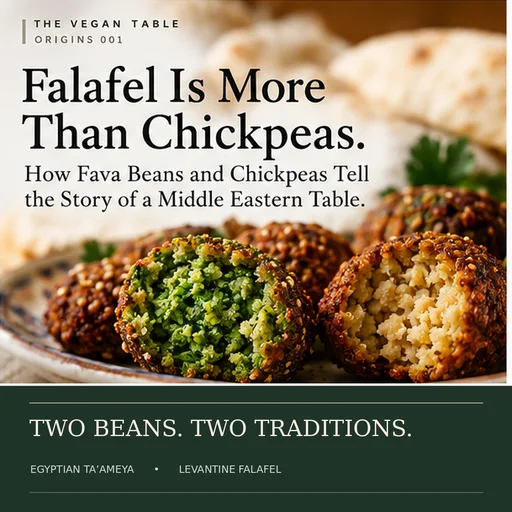
In Egypt, however, a version made from fava beans is popular. It is known as ta'ameya.
In the Levant, including Lebanon, Syria and Palestine, falafel made mainly from chickpeas is widely known.
The ingredients may look similar, but changing the bean changes both the flavour and the texture.
This time, we will show how to make both versions at home.
And once we have explored the recipes, we will follow the history behind these two beans.
02 — Let's Make Egyptian Ta'ameya
Recipe A — Egyptian Ta'ameya
Egyptian ta'ameya is characterised by fava beans and generous quantities of fresh herbs.
Add parsley, coriander leaves and dill, and the mixture turns a vivid green.
Shape it into flat discs, coat the surface with sesame seeds and fry. The aim is to enjoy the contrast between a fragrant crust and a tender centre.
Ingredients (Serves 4; approximately 18–22 pieces)
| Ingredient | Quantity |
|---|---|
| Dried, split, peeled fava beans | 250 g |
| Onion | 70 g |
| Spring onions | 30 g |
| Garlic | 10 g |
| Fresh parsley | 35 g |
| Fresh coriander leaves | 35 g |
| Fresh dill | 20 g |
| Ground cumin | 2 g |
| Ground coriander | 3 g |
| Salt | 6 g |
| Food-grade bicarbonate of soda | 1 g |
| White sesame seeds | 30 g |
| Vegetable oil for frying | As needed |
Allow approximately 12–16 hours for soaking, plus around 60–75 minutes for preparation, resting and frying. Actual hands-on time and yield will vary according to equipment and the size of the fritters.
Method
- Soak the fava beans. Rinse the dried beans and cover with plenty of cold water for 12–16 hours. Refrigerate while soaking for food safety. Once well swollen, discard the soaking water, rinse and drain thoroughly.
- Prepare the vegetables and herbs. Chop the onion, spring onions and garlic. Wash the herbs, dry them well and roughly chop.
- Make the mixture. Place the beans, vegetables, herbs, cumin, ground coriander and salt in a food processor and pulse until finely chopped. Aim for a mixture that holds together when pressed between your fingers; do not blend it into a completely smooth, liquid paste.
- Rest the mixture. Refrigerate for around 20–30 minutes.
- Shape. Immediately before frying, mix in the bicarbonate of soda evenly. Shape the mixture into flat discs around 4–5 cm in diameter and 1.5 cm thick. Press a little white sesame seed onto the surface.
- Fry. Pour oil to a depth of roughly 2–3 cm into a heavy-based pan and heat to 175–180°C. Gently add a few pieces at a time and fry for approximately 4–6 minutes, turning as needed.
- Check that they are cooked. Break open the first piece and check that the centre is thoroughly cooked, with no raw, floury patches remaining. Adjust the time to the size of the pieces and the oil temperature, drain and serve.
The appeal of this dish lies in its herbs.
The freshness of dill, the green flavour of parsley and the gentle sweetness of fava beans come together. Sesame seeds add another layer of toasted aroma.
With plenty of herbs, the inside is more likely to remain green even after frying.
The depth of the colour will, of course, depend on the herbs and quantities used.
03 — Let's Make Chickpea Falafel
Recipe B — Chickpea Falafel
Next comes falafel made from chickpeas.
For this version, we suggest shaping the mixture into small balls.
The chickpeas contribute their own nutty, savoury flavour. The aim is for a crisp exterior and an interior that gently crumbles into fine, tender grains.
Ingredients (Serves 4; approximately 18–22 pieces)
| Ingredient | Quantity |
|---|---|
| Dried chickpeas | 230 g |
| Spring onions | 55 g |
| Fresh parsley | 30 g |
| Fresh coriander leaves | 25 g |
| Garlic | 10 g |
| Ground cumin | 3 g |
| Ground coriander | 2 g |
| Salt | 6 g |
| Vegetable oil for frying | As needed |
Allow approximately 12–16 hours for soaking, plus around 50–65 minutes for preparation, resting and frying.
Method
- Soak the chickpeas. Cover the dried chickpeas with plenty of cold water for 12–16 hours. Refrigerate during soaking. The next day, discard the water, rinse well and drain thoroughly.
- Chop the ingredients. Cut the spring onions, parsley, coriander leaves and garlic into pieces.
- Make the mixture. Pulse the chickpeas and all the other ingredients in a food processor. Leave a little graininess in the beans and aim for a mixture that holds its shape when squeezed in your hand.
- Rest. Refrigerate for around 15–30 minutes.
- Shape. Using a heaped tablespoonful for each piece, gently form small balls about 3–3.5 cm across.
- Fry. Add a few pieces at a time to oil at 175–185°C. Fry for approximately 4–5 minutes, turning when necessary, until evenly golden-brown.
- Finish. Break open the first piece and check that the centre is thoroughly cooked. Drain and eat while warm.
Compared with the fava-bean version, this mixture is designed to bring the flavour of the chickpeas themselves to the fore.
Cumin and coriander complement that flavour, but it is important not to use too much spice.
We do not want to lose the taste of the beans.
There are also green, herb-rich versions of falafel in the Levant. It would therefore be misleading to assume that every green falafel must be Egyptian.
04 — Why Don't We Use Cooked Beans?
This may be the most interesting part of making falafel.
Most bean dishes begin by boiling the beans until tender.
For these two falafel recipes, however, we soak dried beans in water, then grind them without boiling them first.
Why?
The answer lies in the starch and moisture inside the beans.
In cooked or tinned beans, the starch has already been changed by heating. When the beans are ground and fried, they may fail to hold together or produce a heavy, sticky texture.
Some recipes deal with this by adding flour, but that can make it harder to achieve a light result.
By contrast, soaked but uncooked beans still contain starch that has not yet been heated.
When we grind them finely, shape them and place them in hot oil, the moisture absorbed by the beans and the heat of the oil allow the inside to cook during frying.
Soaking and cooking are, in other words, two separate stages.
This is also an important technique explained in the falafel cooking experiments of J. Kenji López-Alt.
Because the mixture begins with uncooked beans, however, frying time must not be judged by colour alone. It is essential to cook the centre thoroughly.
Four Common Problems — and How to Avoid Them
1. The falafel falls apart in the oil.
If the beans or herbs have not been drained properly, or the beans have been left too coarse, the mixture may not hold together.
First check the moisture content and particle size. Chill the mixture thoroughly, then fry a single small test piece.
2. The outside burns, but the inside still seems raw.
The oil may be too hot, or the pieces may be too large.
Shape them smaller and use a thermometer to monitor the oil temperature.
3. The falafel is heavy and oily.
When the oil temperature drops, the finished fritters can become heavy.
Avoid crowding the pan and allow the oil to return to temperature before adding the next batch.
4. The herbs lack flavour.
Dried herbs alone are unlikely to give quite the same flavour as generous quantities of fresh herbs.
If you cannot find fresh dill, you could increase the parsley in the ta'ameya, but the flavour will change.
If you use dried fava beans with their skins still on, you will also need to remove the skins after soaking. For a first attempt, peeled split beans are recommended.
Do not simply substitute the same weight of tinned chickpeas or frozen fava beans. Their moisture content and cooking state are different, so they require a separately designed recipe.
05 — What Should You Serve with Falafel?
Falafel can be eaten by itself, but bread and sauce turn it into a complete meal.
In Egypt, a flatbread known as baladi is used. In the Levant, pita and other flatbreads are popular.
Tomatoes, cucumber, pickles and herbs are added.
Fragrant fried beans meet fresh, juicy vegetables and a tangy sauce.
There is pleasure in eating contrasting flavours and textures together.
Basic Vegan Tahini Sauce (Serves 4)
| Ingredient | Quantity |
|---|---|
| Tahini (sesame paste) | 60 g |
| Lemon juice | 25 ml |
| Cold water | 60–90 ml |
| Salt | 2 g |
| Grated garlic | 2 g, optional |
Combine the tahini with the lemon juice and salt, adding garlic if you like.
Gradually add the cold water, whisking as you go.
At first the mixture may thicken or appear to separate. Continue adding a little water at a time and whisking until you have a smooth sauce.
Stop when it is thin enough to fall gently from a spoon.
Without any animal-derived cream, the natural oils in sesame provide body and richness.
A Suggested Way to Serve It
For four people, prepare four pieces of flatbread, two tomatoes, one cucumber, around 100 g of pickles and some fresh vegetables or herbs to serve with the falafel.
Warm the bread, fill it with vegetables and falafel, and add the tahini sauce.
Use either Egyptian ta'ameya or the chickpea version.
The acidity of the pickles helps to balance the rich fried flavours right through the meal.
06 — Enjoying Falafel as a Vegan Dish
The proposed recipes here use no meat, seafood, dairy products, eggs, honey or other animal-derived ingredients.
However, a dish being called falafel does not automatically guarantee that every restaurant version or manufactured product is fully vegan.
Some variations may include eggs or dairy, while yoghurt sauces, breads or seasonings may also contain animal-derived ingredients.
Always check the ingredients of commercially prepared products and, where relevant, how they have been cooked.
Allergies
Anyone with an allergy to fava beans or chickpeas should avoid the relevant bean.
The sesame seeds on the ta'ameya, sesame in tahini sauce and wheat in bread may also be significant allergens.
With soya, nuts, eggs, milk and other allergens, check the labels of purchased products and consider possible cross-contact through utensils, preparation surfaces or shared frying oil.
Fava Beans and G6PD Deficiency
An especially important issue concerns the safety of fava beans.
People with glucose-6-phosphate dehydrogenase (G6PD) deficiency may develop acute haemolytic anaemia after eating fava beans.
Do not assume that cooking makes the beans safe. People with G6PD deficiency need to avoid fava beans, and anyone affected or concerned should consult a healthcare professional.
With both dried-bean recipes, do not taste the uncooked mixture. Soak and store the ingredients hygienically, and make sure the centres are thoroughly cooked.
Recipe Testing Status
These quantities have been independently assembled using existing cookery sources as references. Both are proposed recipes — not yet kitchen-tested.
Neither the results of cooking nor the taste and texture have yet been verified through actual preparation.
07 — Where Was Falafel Born?
Comparing these two beans raises another question.
Was the first falafel made with fava beans, or with chickpeas?
There are several theories about falafel's origins.
One of the best known places its beginnings in ancient Egypt.
Yet no firm historical evidence has been found to show that the people of ancient Egypt made the same dish we recognise as falafel today.
According to RAWI Publishing, which researches and presents Egyptian food culture, travellers' accounts from before the nineteenth century do not mention ta'ameya, although by the early twentieth century it had become widely familiar in Egypt.
This does not prove that the dish was invented in the nineteenth century.
It does, however, show that the evidence is insufficient to claim with certainty that it represents a tradition thousands of years old.
Was It a Coptic Christian Fasting Dish?
Another well-known theory connects the dish with the fasting traditions of Egypt's Coptic Christians.
The Coptic Orthodox Church observes periods during which animal-derived foods are avoided.
Beans are useful plant-based ingredients during such periods.
There is some plausibility in the idea that a satisfying dish such as ta'ameya developed in response to the need for food without meat.
The food historian Nawal Nasrallah has also pointed to the possibility that Coptic fasting traditions influenced the emergence of falafel.
However, no old recipe has been identified that directly proves falafel was invented for fasting.
It should therefore be presented as one of several important hypotheses.
Another Theory Involves the British
During the nineteenth century, Britain and other foreign powers became increasingly involved in Egypt.
The British military occupation began in 1882.
One theory suggests that British people familiar with Indian fried foods asked Egyptian cooks to make something similar.
India has dishes such as vada, made by grinding beans or pulses and frying them.
There are certainly similarities in technique.
The historian Shaul Stampfer has also discussed the possibility that Indian fried-food traditions influenced the development of falafel.
But similarity between dishes is not proof of direct influence.
There is still room for research into who first devised falafel and when it spread.
Even so, Egypt is clearly a very important place in the story of falafel's development and wider popularity.
08 — Why Fava Beans in Egypt, but Chickpeas in the Levant?
Fava beans are closely woven into everyday life in Egypt.
Ful medames, a dish of slowly cooked fava beans, remains one of the country's best-known breakfast foods.
Ta'ameya, made from the same bean, has also become a natural part of the everyday table.
Meanwhile, chickpeas feature in many dishes in the Levant, including Lebanon, Syria and Palestine.
The differences in falafel ingredients probably reflect such things as cultivation, availability, existing food habits and local preferences.
Yet the distinction is not an absolute rule under which Egyptians always use fava beans and Levantine cooks always use chickpeas.
There are also recipes combining both beans.
Cooking does not fall neatly into categories drawn along national borders.
When Did Ta'ameya Become Green?
Here is a rather surprising story.
One of the best-known features of Egyptian ta'ameya is its brilliant green interior.
According to RAWI Publishing, however, ta'ameya could sometimes be pale or almost white before the 1980s because access to herbs depended on the season.
Dill, parsley and coriander were not necessarily available in steady supplies throughout the year.
As agriculture and distribution changed, it became easier to use fresh herbs at any time, and the green ta'ameya familiar today became more established.
Traditional cooking does not necessarily remain unchanged through the centuries.
As the supply of ingredients changes, so can the colour and flavour of a dish.
Perhaps what we call a 'traditional taste' has itself been shaped by changing times.
09 — When a Small Fritter Becomes a Symbol of Home
Some historical studies describe falafel spreading from Egypt into neighbouring regions. Today, however, it has become a food that represents different culinary cultures in many parts of the Middle East.
In Palestine, it is woven into everyday meals and street-food traditions, and can also be a reminder of home.
In Lebanon and Syria, it is likewise a familiar street-side meal.
In Israel, it was widely adopted into Jewish food culture during the twentieth century and came to be presented as a national dish.
At the same time, Palestinians and others have objected to describing food deeply rooted in Arab culinary traditions as uniquely Israeli.
This is not a question that can be settled simply by choosing a different dish name. It involves histories of migration, state-building and cultural belonging.
Food contains more than flavour. It also holds memories of the places people cherish as home.
That is why, when introducing falafel, we want to respect the different culinary cultures found in Egypt, Palestine, Lebanon, Syria and elsewhere.
10 — One Dish, Many Homes
Making a small falafel fritter does not require an enormous number of steps.
Soak the beans, chop the herbs, add spices, shape the mixture and fry.
Yet this simple process contains a surprising amount of knowledge.
Why soaked beans are used without boiling them first.
How the oil temperature changes the texture.
How different beans produce different aromas and flavours.
And how a similar dish has come to carry different meanings in different places.
You might begin with chickpeas.
Next time, try fava beans.
Comparing the two may reveal just how much a change of ingredient can transform a dish.
And perhaps, through that one plate of food, you might come a little closer to the lives and cultures of distant places.
Falafel is not merely a fried bean fritter.
It carries the tastes of many homes.
References and Sources
- RAWI Publishing — What's for Breakfast in Egypt? — The history of ta'ameya, Egyptian food culture and the seasonality of herbs.
- Hawa Hassan — Ta'ameya (Fava Bean Fritters), Epicurious, 2025 — Reference for methods and quantities using dried fava beans.
- J. Kenji López-Alt — Homemade Falafel, Serious Eats — Soaking, grinding, shaping and frying techniques for chickpeas.
- Shaul Stampfer — Bagel and Falafel: Two Iconic Jewish Foods and One Modern Jewish Identity, 2016 — The history of falafel and questions of cultural identity.
- Arab News — The Feud over Falafel — Origin theories, views including those of Nawal Nasrallah, regional differences and the cultural ownership of the dish.
- MedlinePlus Genetics — Glucose-6-phosphate Dehydrogenase Deficiency — Medical precautions concerning fava beans and G6PD deficiency.
Editorial note: The recipes are original proposed combinations based on the sources above; no cooking or tasting tests have been performed. Before publication, practical testing of quantities, shaping sizes, heating, frying times and final texture would be advisable.