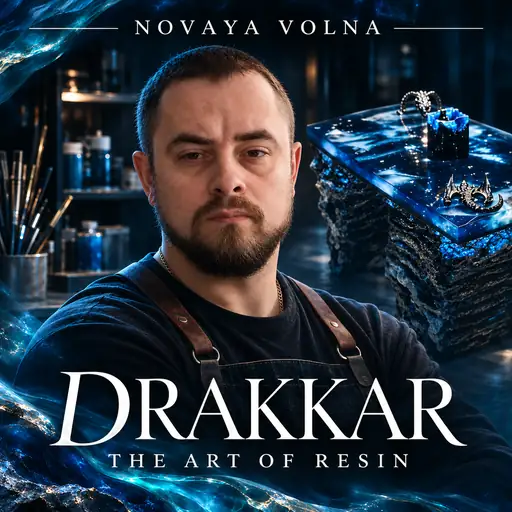
Prologue | When Liquid Turns to Stone
His first creation, he says, was a long way from what he had hoped for.
There were air bubbles, cloudy patches on the surface, and layers that had not set evenly. Yet Alexei did not stop. In watching epoxy resin change from a flowing liquid into a solid form, he had found something he wanted to see again and again.
He describes it as ‘like alchemy’.
Alexei makes clocks and tables. But listen to him, and it becomes clear that he wants to make more than furniture. He tries to set the depths of a river within transparent layers of resin, to enclose time in textures resembling stone, and to bring distant landscapes to life in familiar everyday objects.

Chapter One | It Began with a Photograph
He saw a photograph of a table made with poured resin on the internet. The image stayed with him. He bought a small quantity of resin and decided to try it for himself, using a printed image.
What had gone wrong became a series of new questions. How should the resin be prepared? How did the pigments mix? How would the shape change depending on when the resin was poured?
He tried, made adjustments, and tried again. Within a few months, resin had become much more than a passing hobby.
Chapter Two | Clocks and Tables as ‘Functional Art’
He calls his work ‘functional art’.
Families and friends gather around a table; a clock tells the time. What matters to him is that his creations do not simply sit on shelves to be admired, but are used in someone's everyday life.
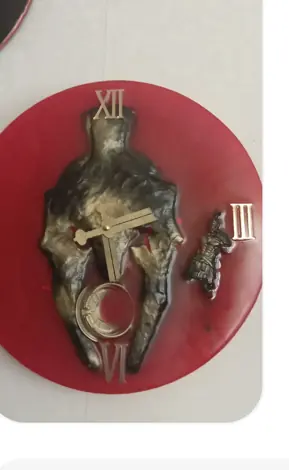
He began with relatively small clocks. Their size made it easier to experiment with and refine his techniques. In time, he moved on to tables, which offered him a much larger surface.
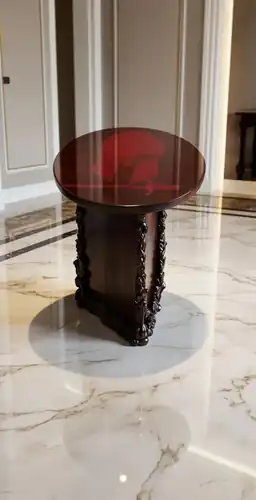
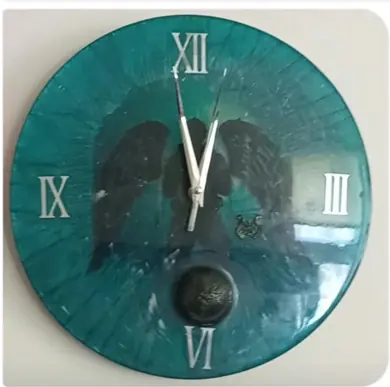
On a round clock face, changing light alters the resin's appearance as the hours pass. Across a tabletop, there is room to suggest rivers, riverbanks and layers of deep water. The material is the same, yet a different form can tell a different landscape's story.
Chapter Three | The Name 《Драккар》
The name 《Драккар》 emerged from the images of the north that Alexei found in resin.
The transparent layers reminded him of northern seas; the movement of pigment suggested the setting sun over a fjord. Water, ice, fire — and a ship sailing onward.
To him, a drakkar is more than the name of a ship. It represents travel, exploration and moving forward. A work, too, can carry the story its maker has put into it as it makes its way into someone's home. That idea became part of the name.
At first, he made things for himself and for people close to him. Encouraged by his friends' reactions, those pieces gradually grew into a project. Perhaps its name had already hinted at the direction it would take.
In his workshop he sometimes listens on YouTube to collections of Scandinavian-style music inspired by the Vikings. He does not follow any one band, instead playing whatever he chooses at the time. Good music, he says, affects both his mood and the way his creative work progresses.
Chapter Four | The Story First, the Colour Last
Making a piece does not begin with the question of which colour to use.
‘Almost always, I start with a story,’ says Alexei. He imagines where the piece will go, who will use the space and what kind of atmosphere he wants the space to have. In an example involving someone who loves fishing, he might picture the light on a river and a dark riverbank.
Then come the materials, with the form emerging in response to the way they move. Colour and texture, he explains, are resolved last.
His sequence is story, material, form, then colour. Looking only at the surface of a finished piece, it is easy to miss that order.
Chapter Five | Treating Resin as Water
When he depicts the sea or a river, he treats resin as water.
For the shallows, he keeps it nearly transparent. For a deep pool, he uses more pigment and builds up multiple layers. He usually limits himself to two or three principal colours, creating depth through variations in concentration and overlapping translucency.
Yet pigments do not always spread as he intends. They may sink, gather unevenly or form unexpected patterns. So he makes repeated small test pours in trays, examining how the colour behaves and flows.
He calls these trays his ‘painter's palette’. It is a palette for seeking the depth of water without a paintbrush.
Chapter Six | The Skill of Waiting for Resin to Set
The process begins with sketches and a review of reference materials. Three-dimensional components, intended to appear enclosed within the resin or as though growing out of it, are adjusted in scale and position through trial pieces. After the necessary preparation, they are incorporated into the resin layers.
Casting — pouring resin into a mould — is not done in one go. He creates a thin base layer, then adjusts the colour and transparency in subsequent layers. He waits for the resin's viscosity to change, choosing the moment to guide the shapes of waves or mist. Once the resin has cured, there is still a long process of sanding, polishing and finishing.
The difficulty, he says, lies in not trying to control the material completely. Temperature, humidity and time all affect the outcome. Rushing a stage can produce unforeseen flaws.
He likens his approach to handling a sail. Rather than forcing his way against the wind, he senses how it moves. He takes the same approach to resin.
Chapter Seven | ‘Dynamic Chaos’ Born from a Mistake
On one occasion, a three-dimensional component he had placed inside the resin tipped slightly away from its intended angle.
Instead of removing it and starting again, he made the tilt part of the composition. By adding other components leaning in the same direction, he created a sense of objects falling or turning in a vortex.
It became the starting point for what he calls ‘dynamic chaos’.
‘Mistakes are my best teachers,’ he says — words that describe the very way he works. An unintended change becomes the beginning of a new form. That flexibility gives his pieces their sense of movement.
Chapter Eight | Placing a Stormy Sky Above Rock
One of the works Alexei feels most attached to is a table.
He calls it 《Игра Престолов》 — Game of Thrones. It was inspired by the world of the story based on George R. R. Martin's A Song of Ice and Fire novels. Yet what stands out in Alexei's account is not the names of its characters, but the question of how to turn ‘stone’ and ‘sky’ into physical objects.
This is a work Alexei made independently; it is not presented as an official Game of Thrones work or an authorised product.
He wanted to move away from his familiar river-like resin effects and make something more dramatic, almost cinematic — a scene charged with tension. He began not with the tabletop, but with its base.
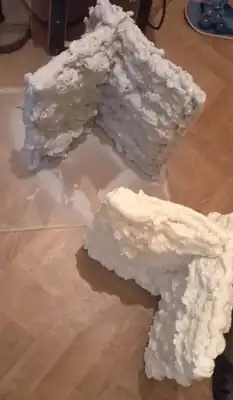
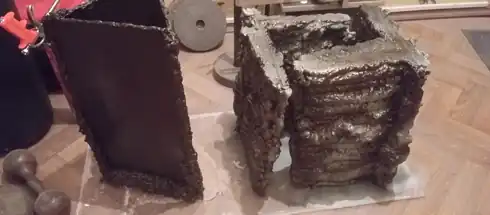
He wanted it to resemble a single massive rock: rough, imposing, almost unapproachable. Alexei says he made the black base from acrylic sheet, shaped its rock-like surface with construction-grade expanding foam and then painted it.
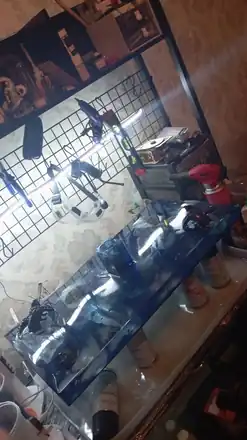
Above that rock-like base, he wanted to place its opposite. The tabletop would become the sky above a fortress. In semi-transparent resin shifting from deep navy to brighter blue, he added fine particles resembling distant stars or sparks. White streaks could be read as thunderclouds or dragon fire. Instead of pouring the resin all at once, he waited for each layer to thicken a little before adding the next, creating moving currents of colour rather than flat patterns.
His description also includes small metal dragon figures and a cube emitting blue light. He regards these as references to the symbolism of House Targaryen and to the magic of ice and fire. Rather than merely placing the ornaments on top, he planned their positions, partially embedded them in the resin and polished the joins, aiming to make them part of the landscape.
There is an idea here that goes beyond decorating furniture.
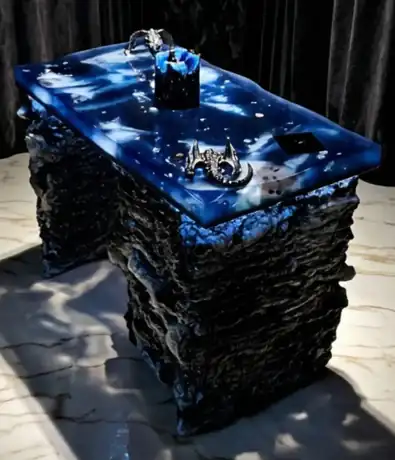
Light falling across the uneven, rock-like base casts shadows, while the sky of the tabletop changes with the light. Small forms are enclosed in transparent layers, and another view appears as the angle shifts. Rather than painting a picture of the story's setting, Alexei uses the properties of the materials themselves to bring a sense of that world into an everyday object.
The people who gather around that table in someone's home may know nothing of Game of Thrones. Even without knowing the story, they might still sense something in the suggestion of a stormy sky spreading above rock.
For someone who sees furniture as ‘functional art’, the story does not end when the object is completed. It begins again whenever the piece is used, observed or catches the light.
Chapter Nine | The Quiet of Kobrin
‘Kobrin and Belarus are my anchor and my compass,’ he says.
The wind crossing the Mukhavets River, ripples on the water, old trees and a sky turning violet at dusk: such familiar sights help him think about the colours and forms of his work.
Equally important is the quiet. It gives him a chance to watch the material moving slowly and wait for the moment when a form emerges. He says the town gives him the time and space to create.
The light of the place he knows is alive in works that dream of distant northern seas.
Chapter Ten | The ‘Hall of Drakkars’ That Does Not Yet Exist
Alexei has an ambitious dream that has yet to take shape: an exhibition space he calls the ‘Hall of Drakkars’.
At its centre would be a large table depicting the topography of the seabed like a map. Around it would stand clocks and smaller pieces of furniture representing water, wind, stone and fire. Concealed light in the darkness would illuminate the resin layers, making their apparent depth change as visitors moved around them.
For now, this is a plan, not a completed exhibition. But to Alexei, each small clock he makes and every pour of resin is another step towards that hall.
Epilogue | When Liquid Turns to Stone, and Beyond
Bubbles remained and the resin turned cloudy in that first pour.
The material is not always obedient, even now. Yet he pours another layer.
And he imagines a day when people will gather around one of his pieces and someone will see a landscape of their own in it.
Follow the Artist | TikTok
Alexei's TikTok, shared by the artist himself: Drakkar — The Master of Resin