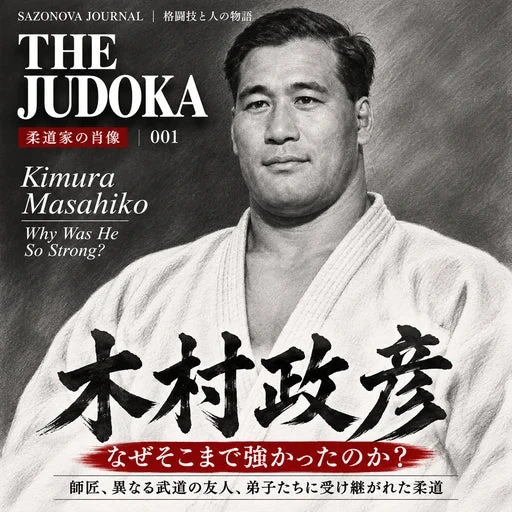
Prologue | The Day There Were Two Winners
On 5 May 1949, the final of the All-Japan Judo Championships took place at a temporary sumo arena in Nihonbashi-Hamacho, Tokyo. More than twenty blue tatami mats had been laid over the sumo ring to create a special contest area.
Masahiko Kimura, representing Kyushu. Takahiko Ishikawa, representing Tokyo.
The contest went into extra time. Then more extra time. Then another extension. Still, neither could establish superiority. The All Japan Judo Federation's chronology records the extraordinary result: two champions.
Kimura is one of the most celebrated men in judo history for having remained undefeated. Yet there is something here that is easily overlooked.
Not losing and always managing to win are not the same thing.
Ishikawa did not defeat Kimura. But Kimura did not defeat Ishikawa, either.
We know the saying, 'There was no Kimura before Kimura, and there will be no Kimura after Kimura.' But how much do we know about the opponent who stopped that man from winning outright?
I want to begin our search for the source of Masahiko Kimura's strength not by counting his victories, but with this final that nobody won alone.
Chapter One | Who Raised the Prodigy from Kumamoto?
Masahiko Kimura was born in 1917 in Kawashiri, Kumamoto Prefecture.
As a boy, he was not devoted exclusively to judo from the beginning. He was also passionate about sumo and became known for contests in which bodies collided. At the old-system Chinzei Middle School, he took up judo and developed his talent further.
In 1935, he entered Takushoku University.
There he met Tatsukuma Ushijima, the fearsome judoka nicknamed 'Demon Ushijima'. Their strict master–pupil relationship would shape a career that cannot be explained by numbers alone.
Takushoku University's official account describes Kimura as a student who tied a belt around a tree and repeated as many as one thousand entries for throws in a day.
It makes a striking story about a prodigious training workload. But it would be a pity to stop at amazement over the number.
Uchikomi is the repeated practice of the movement leading up to a throw, without completing the throw. Close the distance to an opponent. Bring the gripping arms and legs into a single movement. Enter as the other person's balance breaks. Deliberately retrace the trajectory of a successful attempt.
Exactly how many days the thousand repetitions continued, and under what conditions, still requires checking. Even so, the direction of the training is clear: not a single act of brute strength, but the attempt to recreate the same situation again and again.
Ushijima's severity alone cannot explain Kimura's strength. What matters is that an exceptional talent was placed in an environment that demanded repetition and competition.
A teacher's reputation rises when his pupil wins; defeat can cast doubt on his teaching. Perhaps the two were pursuing something greater than victory in a single tournament.
Chapter Two | Who Inherited Kimura's Osoto-gari?
For many judoka, Kimura's name immediately brings osoto-gari, the major outer reap, to mind. Yet to write merely that his osoto-gari was devastating is not to understand the technique.
In osoto-gari, one breaks an opponent's balance backwards and reaps the leg on which they are supported. But if the opponent still stands securely on both feet, speed of the reaping leg alone will not bring them down. The hands unbalance; the body closes in; weight is committed; the leg reaps. The order and coordination determine the outcome.
According to a later published English translation of a conversation between Masahiko Kimura and Gozo Shioda printed in 1987, Kimura argued that growing stronger required more than repeating forms: one must also understand the purpose of each movement. The hands, the lowering of the hips and the tightening of the arms change according to where one intends to throw an opponent. Mechanically repeating the same movement against people of different heights is insufficient.
To understand Kimura's particular osoto-gari, therefore, we need more than footage of Kimura himself. We must ask how pupils who had felt the technique explained what they learned.
At the centre of that story is Kaneo Iwatsuri.
A direct pupil of Kimura and the 1971 All-Japan Judo Champion, Iwatsuri sought to pass on his teacher's osoto-gari in the 2004 instructional video <i>Masahiko Kimura: Oni no Judo</i>. Its producer's published contents cover opponents of equal height, taller opponents, an unconventional left-sided grip, differences from the conventional osoto-gari, and the timing of the throw.
Even the list of topics tells us something. This was not being handed down as a fixed position to imitate, but as a technique whose conditions must change with the opponent.
We have not watched the complete DVD. It would therefore be wrong to invent details about the angle of the reaping leg or the use of the upper body. That would be a dangerous shortcut to believing we had discovered the secret of Kimura's strength.
Another recollection survives. Yoshinori Nishi, who later explored a range of martial arts, says he asked Kimura as a schoolboy where the weight should fall on the supporting foot during osoto-gari. According to a 2024 interview with Nishi, Kimura told him to place it towards the inside of the middle toe. Nishi later recalled that perhaps only Iwatsuri had been able to master such subtle weight distribution fully.
This is not a universal law of biomechanics for every judoka. It is one pupil's memory of advice given by Kimura. Yet its specificity matters. The legendary thousand repetitions are suddenly brought down to a tiny point on the sole of a foot.
At the Western Japan Judo Championships in July 1947, Kimura fought Yasuichi Matsumoto through successive extensions before winning by an advantage gained through a hold-down. Against Yoshihiko Yoshimatsu, he scored waza-ari with osoto-gari before finishing with ippon-seoi-nage.
Osoto-gari was not his only way to control an opponent. There were ground techniques and combinations too.
Mastering one technique does not mean using only one technique. Perhaps what Kimura truly left his pupils was not a finished version of osoto-gari, but the conviction that a technique must always be studied.
Chapter Three | The Men Whose Contests Had No Winner
On 15 March 1948 in Fukuoka, Kimura faced Yasuichi Matsumoto.
According to the All Japan Judo Federation's chronology, Kimura applied waki-gatame from a standing position; the two became entangled and fell outside the contest area. Matsumoto cut his lip and bled. Both wished to continue, but the referee declared no contest.
How, then, should we read Kimura's 'unbeaten' record?
He did not lose. But he did not win, either.
That same year Matsumoto went on to win the first post-war All-Japan Judo Championships. The opponent who had stopped Kimura was himself a judoka capable of reaching the summit of the sport in Japan.
The following year, even three extensions could not settle Kimura's final against Takahiko Ishikawa, and the championship was shared.
The legend of Kimura's 'fifteen undefeated years' includes such no-contests and joint titles. Takushoku University's official biography gives fourteen years without defeat in official competition. Before arguing over fourteen or fifteen, we should establish which tournaments and which contests are being counted.
Kimura's three consecutive titles in the pre-war Japan Championship competitions of the 1930s, and his victory at the 1940 imperial martial arts tournament, lose nothing when the numbers are handled with care.
Indeed, knowing that he faced formidable opponents and contests he could not easily win lends real weight to the fact that they could not make him lose.
Erase the rivals and even the champion's outline begins to fade.
Chapter Four | Gozo Shioda, a Friend Who Took Another Path
Kimura's strength is often measured entirely by the standards of judo. Yet Takushoku University in his day was also home to men who trained their bodies in other martial arts and searched for different answers.
One was Gozo Shioda.
Shioda studied aikido under Morihei Ueshiba and founded Yoshinkan Aikido after the war. He and Kimura were contemporaries at Takushoku University, and a conversation between them appeared in <i>Full Contact KARATE</i> in 1987. The remarks and anecdotes presented here are summarised from a later published English translation; we have not compared them word for word against the complete original Japanese magazine.
It was not an exercise in deciding which of two martial arts masters was stronger. It was a precious exchange, moving from stories of their student days to the things that training leaves in the body.
Shioda recalled that he, Kimura and the karate practitioner Isao Fukui had been known at university as the 'three crows', or a famous trio. Fukui, he said, had doubted the strength of judo and aikido, and they had once tested their skills in the gymnasium. Kimura also remembered arm-wrestling Shioda and being surprised by the smaller man's strength.
Their recollections differed over the precise number of wins. But the very fact that they could laugh about it shows how comfortable they were with one another.
The conversation deepened when Kimura began discussing his training. He described early-morning chores under Ushijima, visits to different dojos, striking a makiwara and solitary practice late at night. The quantities he gave were extraordinary. We cannot scientifically verify that he did exactly the same amount every single day, but we can see how he remembered a life shaped by repetition.
The exchange shows both men valuing repetition while discussing technique in the different languages of their martial arts. Kimura considered how to break balance and the direction of a throw; Shioda spoke of the aikido concepts of breath power and the centre line. That did not make their techniques identical. Yet they shared an interest in preparing the body before bringing force to bear on an opponent.
We need not use Shioda's words as proof of Kimura's judo, or imagine an official duel between them. It is far more interesting to portray them as friends who chose different martial arts yet continued to question their training as they grew older.
Kimura was not merely a 'demon of judo'. He could also enjoy somebody else's strength and listen with curiosity to another form of technique.
Chapter Five | A Judoka Had a Life Beyond the Dojo
After the war, Kimura's life was confronted by problems that do not appear in a list of sporting results.
However strong one may be at judo, strength alone does not feed a family.
Post-war judo organisations were rebuilding. Judo was not permitted to return to schools until September 1950. In the years of reconstruction, the dignity of a sport existed alongside the need for competitors and instructors to earn a living.
In March 1950, the International Judo Association was established to place professional judoka at the heart of public entertainment. In April, Kimura defeated Toshio Yamaguchi to win its inaugural All-Japan Professional Judo Championships. But the organisation disintegrated after little more than four months, according to the federation's history.
An ambitious undertaking lacked a secure economic foundation.
It would be unfair to reduce Kimura's move from professional judo to professional wrestling to a man abandoning honour in pursuit of money.
Later accounts based on an interview with Kimura in 1983 also mention his wife's illness and the financial burden of her treatment. The details, however, must be checked against the original magazine.
What matters is that Kimura was trying to find a way to make his ability as a judoka into a livelihood in a new, post-war society.
To show spectators strength. To make them want a contest to continue. To persuade them to pay to watch.
This was a different logic from judo, where a contest ends when an ippon is scored.
Beyond the tatami, Kimura had entered another kind of contest.
Chapter Six | In Brazil, an Ippon Was Not the End
Brazil, 1951.
Kimura faced Hélio Gracie, a leading figure in Gracie jiu-jitsu.
The bout was remarkable not only for its later significance in the development of mixed martial arts. Its rules for deciding a winner differed from those Kimura knew in judo tournaments.
A throw alone would not win the match. Nor would holding an opponent down for the usual prescribed time automatically produce ippon. The contest continued until one man submitted or could no longer go on.
Gracie had already faced Yukio Kato, another member of the visiting Japanese party. Their first encounter ended in a draw; in the rematch Gracie won by a choke. Kimura therefore entered the ring amid enormous expectations as a representative of Japanese judo.
He threw Gracie and eventually applied ude-garami, an entangled arm lock. The bout is reported to have ended when Gracie's side conceded.
One familiar story requires care: the claim that Kimura broke his opponent's arm. Accounts in contemporary reporting and later testimony differ over the extent of the injury and exactly how the contest was stopped.
What matters is that Kimura's victory is recorded, and this kind of arm lock later became known across the martial arts world as the 'Kimura'.
It is fascinating to consider the techniques themselves.
Osoto-gari disrupts the place on which a standing opponent relies and brings them down. Ude-garami controls an arm and limits the directions in which an opponent can escape. The movements look utterly different, yet each reduces the other's freedom of action.
Rather than allowing a single dramatic throw to stand for all of Kimura's judo, we should see a man who could create a chance to win against an opponent standing or on the ground.
And in a place with different rules for victory, Kimura won.
Chapter Seven | What Did Mas Oyama Admire in Kimura?
Among the martial artists who looked up to Kimura was Mas Oyama, who would later found Kyokushin Karate.
Yet depicting them as lifelong intimate friends from the outset would flatten the history.
Oyama is said to have known Kimura's name when his competitive achievements became famous and to have regarded the renowned judoka as a symbol of strength. A review of <i>The True Biography of Mas Oyama</i> by Kazushi Kojima and Yoshiko Tsukamoto, however, suggests that the young men were not necessarily close and that their association deepened around 1953.
Kimura had made his name in judo. Oyama wanted to demonstrate the strength of karate to society.
What linked them was neither a shared school nor the same rules. Perhaps it was the question hanging over their era: what makes a person strong?
Accounts discussing Toshinari Masuda's biography also preserve claims that Oyama valued Kimura's contests highly and held the speed of his osoto-gari in his prime in special respect. But we still need to confirm exactly where and when Oyama's own words were recorded.
More dramatic stories surround the 1954 bout with Rikidōzan. One says that Oyama stood up in anger at ringside when Kimura was defeated and had to be restrained. Other recollections claim that Oyama subsequently sought a confrontation with Rikidōzan.
These should not be combined into a sentimental tale of a vow to avenge Kimura. Other accounts point to Oyama's own competitive feelings towards Rikidōzan and earlier tensions between them.
A karate practitioner who admired a judoka; two men navigating the new world of sporting entertainment; three lives complicated by the Rikidōzan bout.
This is not the place to invent a ranking of who would win a street fight. The real subject is how karate, judo and professional wrestling in post-war Japan each sought to display, commercialise and defend their idea of strength.
Chapter Eight | Why Has the Rikidōzan Bout Never Really Ended?
22 December 1954, Kuramae Kokugikan.
The encounter between Rikidōzan and Masahiko Kimura, called the 'Ganryujima Duel of the Shōwa Era', is unavoidable in any account of Kimura's life.
The difficulty is that almost everybody already knows the result. Rikidōzan launched a succession of fierce blows and Kimura was defeated.
There are three questions. What arrangements had been made for the bout itself? What was planned for subsequent matches or tours? And how should we interpret the kick's point of contact and the film footage? Beyond the result, the participants' recollections diverge.
Issue 78 of the 1955 magazine <i>Shinsō</i> carried an article on the circumstances of the bout. In text that a later personal blog presents as a reproduction from that issue, Rikidōzan is said to have maintained that Kimura had asked for a draw but he had not agreed. Kimura, in contrast, is said to have explained that the first bout was arranged on the understanding that it would end in a draw.
The article's existence is verified by the Shōwakan archive catalogue. We have not, however, checked the original pages of <i>Shinsō</i> for the exact wording of their statements or the journalist's framing. These cannot be quoted as independently established verbatim remarks.
In 1983, Kimura spoke again during his lifetime about the arrangements for the Rikidōzan bout. Issue 70 of <i>Number</i> preserves his explanation that the first bout was to end in a draw and that subsequent winners would be decided by rock-paper-scissors as they toured.
This account does not match every detail of the explanation attributed to him in 1954. Nor should arrangements for each fall of a three-fall contest be confused with plans for rematches on different dates.
In 2018, Mitsuo Momota, Rikidōzan's son and himself a professional wrestler, questioned the sporting fairness of Kimura's decision to speak in detail after his father had died.
Here too we must be precise. It is not correct to say Kimura first spoke about the affair in 1983. If his remarks reported in <i>Shinsō</i> in 1955 are accurately represented, he had discussed the circumstances while Rikidōzan was still alive.
We cannot simply disregard Momota's objection. Nor can we assert that Kimura remained silent throughout Rikidōzan's lifetime.
The kick to the area around the groin is similarly disputed. Momota says a kick by Kimura provoked Rikidōzan's violent response. In Kimura's later account he denied kicking his opponent in the groin. People who have watched the footage have also interpreted the contact differently.
That an action appears on film does not prove an athlete's intention or the existence of a prior conspiracy.
To tell the story only as that of a tragic judo king felled by a dishonourable Rikidōzan would erase the business of entertainment in which Kimura had himself taken part. To describe him solely as a man technically inferior at professional wrestling would prevent us from asking what he had agreed to and what departed from his expectations.
Who was trying to protect what in that bout, and who broke what promise?
The film of the result cannot, by itself, provide the answer.
Chapter Nine | Kaneo Iwatsuri: The Demon's Judo in Another Body
If we end Kimura's life story with his defeat by Rikidōzan, we lose half his work.
In 1961, Kimura returned to Takushoku University as an instructor to the judo club.
The pupil who came to symbolise this new era was Kaneo Iwatsuri. Born in Kumamoto Prefecture in 1944, like Kimura before him, Iwatsuri began judo at secondary school and studied under Kimura at Takushoku. He would later be described as Kimura's foremost pupil.
In 1965, the university's judo team won the Tokyo Student Judo Team Championships and then the All-Japan Student Judo Team Championships. The university's official chronology and the recollections of participant Etsuo Anzai give this year. A related publisher's timeline gives 1966 instead, so there is a discrepancy between sources. Accounts of those involved nevertheless indicate Iwatsuri's contribution to the team.
It is easy to say that a pupil surpassed his master. But a championship alone cannot explain what Kimura passed on when he became a teacher.
Iwatsuri joined the Hyogo Prefectural Police in 1966 and distinguished himself in police judo. In 1969 he won an international sambo tournament in Moscow. Then, on 29 April 1971, he defeated Nobuyuki Sato to become All-Japan Judo Champion.
He had repeated in a different era, against different rivals, the feat of becoming number one in Japan that Kimura had achieved as a competitor.
Nor did Iwatsuri stop when he won. In <i>Masahiko Kimura: Oni no Judo</i>, released in 2004, he demonstrated and preserved Kimura's osoto-gari and groundwork. The production also includes a conversation with Hisao Takahashi remembering their teacher.
An athlete's body must one day leave competition. But footage of a pupil teaching a technique remains even after that pupil has gone.
Kimura could not leave a complete visual record of all his own bouts. Yet some of the questions he passed on remain in the techniques taught by Iwatsuri.
The instructional footage Iwatsuri left behind offers later generations a starting point from which to reconsider Kimura's techniques.
Kimura's strength became a challenge for the next generation, embodied in his pupil's skill.
Chapter Ten | Not Just One Great Teacher: Takahashi, Hanashima, Fujino, Anzai and Nishi
It would be equally misleading to speak of Iwatsuri as Kimura's only pupil.
In 1963, Etsuo Anzai, then a student at Kamakura Gakuen High School, met Kimura, who had come to recruit him for university. Among the students accompanying Kimura were Hisao Takahashi, Kikuo Hanashima, Teruya Fujino and Kaneo Iwatsuri. Anzai remembers practising randori with Iwatsuri, and that on the same day Kimura went to meet Anzai's father.
This small story shows Kimura the educator: gathering people, setting them against one another in practice, and seeing a student's admission through with the family.
The next day Anzai joined the university's summer training camp. There, he says, Riichiro Watanabe, teacher of the then reigning All-Japan champion Isao Inokuma, asked Kimura for advice on Inokuma's ippon-seoi-nage. Kimura declined on the grounds that it was not a technique that could be taught in a few moments.
There is an important distinction here. Inokuma should not be called Kimura's pupil. He studied under Watanabe and had a connection to Kimura through his instructor.
Nor should the anecdote lead us to call Kimura cold-hearted. His refusal to treat a technique as something that could be taught in minutes is consistent with the understanding and repetition he emphasised in the 1987 conversation with Shioda.
Yet Anzai's reminiscence contains a darker side.
Training at Takushoku in Kimura's day reportedly included continuing chokeholds until the partner lost consciousness, carrying heavy boxes upstairs, swimming in bitter cold and being summoned to train late at night. Some practices involved dangers that would be unacceptable under today's safety standards.
The fact that strong competitors emerged cannot justify everything that happened. We must distinguish training that developed technical skill from practices that merely increased fear or the risk of injury.
At the same time, Anzai says Kimura gathered all his competitors in a yakiniku restaurant on the eve of a championship and congratulated them on winning before a single match had taken place. When they did win the next day, Anzai wrote, they felt relief before joy.
It conveys both a teacher's powerful confidence and the weight of his expectations on young competitors.
A later generation included Yoshinori Nishi. Deeply struck by Kimura's manner of walking as a schoolboy, Nishi also encountered Kimura's teaching at university.
Nishi completed his time in the Takushoku University judo club and moved to Sendai after graduating. There he studied judo seifuku, a form of traditional Japanese manual therapy, while also training in kickboxing. He later ventured into other combat sports.
A teacher's influence is not carried forward only by pupils who become champions in the very same sport.
It survives in those who choose another place and another challenge. Nishi's career shows us that.
Chapter Eleven | Techniques Cross Oceans: Doug Rogers and Rashwan
Kimura's judo did not reach only Japanese pupils.
At the 1964 Tokyo Olympics, Canada's Doug Rogers won silver in the heavyweight judo division, losing the final to Isao Inokuma. Afterwards he remained in Japan and trained under Kimura at Takushoku University.
Canada's judo organisation records this as part of its official history. Rogers went on to win bronze at the 1965 World Championships. A short film, <i>Judoka</i>, made by the National Film Board of Canada, preserves a record of his training in Japan.
What did Kimura show a young man from overseas who had come to Japan through judo? What did the physically larger Rogers seek to learn from the smaller Kimura?
To answer in detail, we would need to watch the film itself and cross-check Rogers's own testimony. But the fact that Kimura taught an athlete of a different build and language already shows the growing reach of his teaching.
Iwatsuri, too, carried his teacher's techniques abroad.
After retiring, he coached at Takushoku University and served as head coach of the Egyptian team at the 1988 Seoul Olympics. That team included Mohamed Ali Rashwan, who had faced Yasuhiro Yamashita in the open-weight final at the 1984 Los Angeles Olympics.
From Kimura to Iwatsuri. From Iwatsuri to judoka competing across the world.
We should resist calling this a simple three-generation succession of victorious master and pupils. More than one coach worked with Rashwan, and there is no justification for crediting his 1984 silver medal solely to Iwatsuri.
Still, it matters that Iwatsuri, who studied Kimura's techniques in the 1960s, was teaching judo in Egypt in the 1980s.
In 1951, Kimura fought under unfamiliar rules in Brazil. In the 1960s he taught Rogers. His pupil Iwatsuri then trained athletes in another country.
Such a history challenges the notion that Kimura's sporting life ended with the Rikidōzan bout.
The result of a contest is inscribed on one person's body on one particular day. When a technique is taught to another, however, the competitor's time reaches far beyond it.
Chapter Twelve | Beyond the Ring: From Takushoku Judo to Professional Wrestling
After Kimura's defeat by Rikidōzan, students who revered the 'demon of judo' continued to gather at Takushoku University's dojo. Yet the skills and relationships he fostered there led not only to judo, but also to the professional wrestling ring.
To understand that boundary, we must begin with the transfer that never happened: Kaneo Iwatsuri's.
Iwatsuri won the All-Japan Judo Championships in 1971. In 1976 he was poised to join All Japan Pro Wrestling, but negotiations between Giant Baba and Takushoku University broke down, and the move never took place. A story also circulated that he wanted to avenge Kimura's loss to Rikidōzan. Yoshinori Nishi, who had studied under Iwatsuri, acknowledged hearing that rumour at the time but questioned whether it was truly his motivation. Perhaps he was considering professional wrestling as a way to earn a living.
We cannot claim, then, that Iwatsuri's unrealised transfer was unquestionably an attempt to avenge his teacher.
A later Takushoku judo graduate who did become a professional wrestler was Kazunari Murakami.
Murakami says that during his fourth year at university, senior judoka Yoshinori Nishi encouraged him to enter a combat-sports tournament. He began mixed martial arts with Wajutsu Keishukai in 1995, trained under Satoru Sayama to learn striking techniques, and after meeting Antonio Inoki became a professional wrestler in 1998.
There is no basis for describing Murakami as a direct pupil of Kimura. The connection runs across generations: Kimura helped shape the judo environment at Takushoku, Nishi emerged from it, and Nishi led Murakami towards combat sports.
At the Tokyo Dome on 4 January 1999, Murakami was among Ogawa's seconds when a brawl broke out around the bout between Naoya Ogawa and Shinya Hashimoto. In a 2021 interview he said he had not known the circumstances behind the match in advance and entered the ring intending to protect Ogawa.
We cannot describe Kimura's 1954 bout with Rikidōzan and the 1999 Ogawa–Hashimoto contest as the same kind of 'script-breaking' incident. Even so, Murakami's path from the Takushoku judo tradition Kimura helped shape into professional wrestling, where competitive skill and entertainment meet, offers a point of comparison.
Another wrestler encountered Kimura by a different route: Keiji Muto. Muto has said that as a schoolboy he joined a Takushoku University judo training camp in Yamanashi and acted as Kimura's partner for uchikomi. He later became one of professional wrestling's most prominent figures, but should not be mistaken for a Takushoku student or a formal pupil of Kimura.
Kimura himself experienced professional wrestling in Hawaii and the United States and stepped into its ring. To say that he never entered that world would be false.
Yet the man who had demonstrated overwhelming strength in judo could not remain at the centre of professional wrestling in the same way. People connected to Takushoku in subsequent generations crossed that boundary at different points as the times changed.
Kimura left behind more than judo techniques. He also left a history of people travelling between tatami and ring, repeatedly asking what 'real strength' means and what it means to stage a contest for an audience.
Epilogue | How Should We Read 'There Will Be No Kimura After Kimura'?
Why was Masahiko Kimura so strong?
Counting the contests he won cannot answer that question.
The relentless repetition he learned as a young man cannot be separated from Tatsukuma Ushijima's teaching. His osoto-gari was sustained by the study of how a technique must change to suit an opponent's body. Men such as Takahiko Ishikawa and Yasuichi Matsumoto were formidable enough that he could not always force a decisive result.
His conversation with Gozo Shioda preserves the image of two friends who learned different martial arts at the same university and continued to question how technique works. His association with Mas Oyama reveals how martial artists before and after the war shared, and sometimes competed over, ideas of strength.
Nor can everything Kimura lost be measured by the bout with Rikidōzan.
That defeat certainly cast a long shadow over the words he spoke in later years. But if we make it the end of his life story, we erase the students of 1965, Kaneo Iwatsuri in 1971, Doug Rogers who crossed an ocean to train with him, and the athletes Iwatsuri went on to teach abroad.
When we call someone 'the strongest', we often strip away their doubts, the fear their pupils felt, the contests they could not win and their curiosity about people who practised other techniques.
Such a portrait is easy to understand. But it is too small for the real human being.
'There was no Kimura before Kimura, and there will be no Kimura after Kimura.'
Perhaps the saying lives on because Masahiko Kimura displayed strength so extraordinary that it seemed to set him apart.
Yet the victories were not all he left behind.
There was Kaneo Iwatsuri. There was Etsuo Anzai. There were Hisao Takahashi and others. There was Doug Rogers, who crossed the sea to learn from him. And there was Yoshinori Nishi, who took what Kimura had taught him along another path.
They were not trying to become the same person as Kimura. In their own places, they refined what they had received from him and passed it on to another era.
There was only one Masahiko Kimura.
But his judo did not end with him.